- YouTube For Books Course
- Posts
- STEM Adventure Story Prompts for Kids Review with PLR Right
STEM Adventure Story Prompts for Kids Review with PLR Right
500 Creative STEM Story Ideas That Help Kids Explore Science, Solve Problems, and Build Curiosity Through Fun Adventures

David Lee
March 23, 2026
What Is STEM Adventure Story Prompts for Kids?
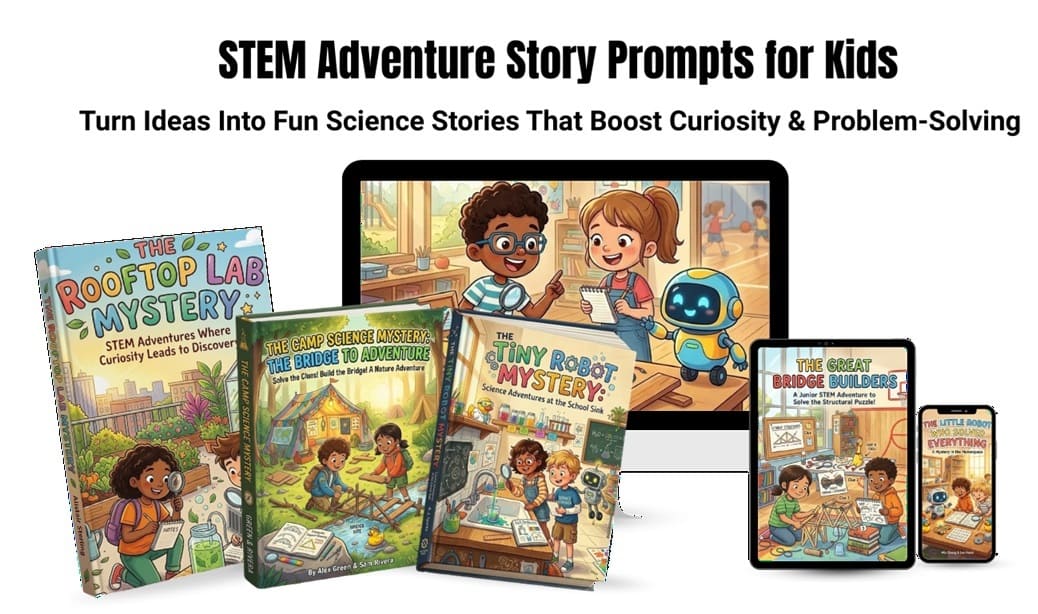
STEM Adventure Story Prompts for Kids is a collection of 500+ ready-to-use STEM story prompts designed to inspire creativity, curiosity, and logical thinking in children aged 7 to 12.
Each prompt acts like the starting point of a fun science adventure. Kids are introduced to a scenario — such as a mysterious experiment, a robot helper, or a bridge-building challenge — and from there, the story grows as they explore solutions, test ideas, and think like young scientists.
What makes this product unique is that it combines storytelling with science learning in a natural way. Instead of simply reading about experiments or concepts, children become part of the discovery process.
The prompts can be used in multiple ways:
Writing science-based stories
Creating STEM activity books
Developing educational content
Generating children’s books using AI tools
Classroom or homeschool learning activities
Publishing books on platforms like Amazon KDP or Etsy
Another interesting feature is how the prompts work with AI tools. You simply copy a prompt and paste it into platforms like ChatGPT, Claude, or Gemini. Within seconds, the AI generates a full story or chapter structure that expands the idea into a complete learning experience. This means you’re not just getting ideas — you’re getting a system that helps turn those ideas into full children’s STEM books.
STEM Adventure Story Prompts for Kids Review - Key Features
✅500+ Ready-to-Use STEM Story Prompts
The core of this product is the collection of 500 STEM adventure prompts created specifically for children ages 7–12. Each prompt is designed to spark curiosity and guide kids through a simple science-based situation or challenge. Rather than just giving a story idea, the prompts encourage kids to think about:
What is happening
Why it is happening
How to solve the problem
What experiment or idea might work

✅Each Prompt Works Like a Mini Book Blueprint
One feature I personally found very useful is that every prompt isn’t just a sentence or concept. Instead, each one acts like a complete mini blueprint for a children’s book. Inside each prompt structure, you typically get:
A STEM story title that attracts young readers
A subtitle that explains the learning concept
A short book description suitable for parents and educators
SEO keywords for publishing on platforms like Amazon KDP or Etsy
A cover design prompt for generating illustrations
10 chapter prompts to expand the story
✅Designed to Encourage Real STEM Thinking
A lot of children’s prompt collections focus only on storytelling. What makes this one different is that it’s built around real STEM thinking. Each story scenario encourages kids to:
Observe situations carefully
Ask questions about what they see
Test simple ideas
Solve everyday problems
Understand cause and effect
✅Five Engaging STEM Adventure Themes
To keep the content exciting and varied, the prompts are organized around five main STEM adventure themes that children naturally find interesting. These include:
Science Lab Mystery: Kids discover a strange experiment or scientific situation and try to understand what happened.
Bridge Building Challenge: Children work together to design and build a stronger structure using creative thinking.
Robot Helper Stories: A robot helps solve problems at school or home using logic and simple systems.
Volcano Experiment: A science project leads to unexpected results that require investigation.
Solar Energy Project: Kids explore how sunlight can be turned into useful energy.
✅Easy Integration With AI Tools
Another feature that adds a lot of convenience is how easily these prompts work with AI writing tools. The process is simple:
Copy a prompt from the pack
Paste it into ChatGPT, Claude, or Gemini
Generate a story or chapter instantly
✅Perfect for Creating Multiple Types of Content
One thing I noticed while exploring this product is how flexible it is. You’re not limited to just one type of project. You can use the prompts to create:
Children’s STEM storybooks
STEM activity books
Creative writing workbooks
Educational journals
Printable learning materials
Interactive classroom activities
✅Private Label Rights (PLR) Included
Another important feature is that this product comes with PLR rights. This means you can:
Edit the prompts
Customize the content
Add your own branding
Publish books under your name
Sell the final product
✅Bonus Educational Resources Included
Along with the main prompt collection, the package also includes several bonus workbooks and activity materials related to STEM learning. Some examples include:
STEM Activity Book for Kids
STEAM Explorers Workbook
Genius Kids STEM Activity Book
Fun Science Experiments for Kids
Sensory Regulation Calm Workbook
How Much Does STEM Adventure Story Prompts for Kids Cost?
❤️ STEM Adventure Story Prompts for Kids Front End ($14.95)
I grabbed STEM Adventure Story Prompts for Kids for $14.95, and honestly, it's already changing how I think about keeping my 9-year-old engaged.
Here's the thing that hit me: Kids don't get bored because learning is tough—it's because it's so predictable. Same worksheets, same answers, same "right way" every time. No surprises, no real discovery, and curiosity just fizzles out.
But these prompts? They flip that script. Picture this: A volcano experiment goes haywire. A bridge kids build collapses mid-test. A robot picks the wrong path. Suddenly, it's "Wait—what now?" No scripted answer, just that perfect question: "Let's figure it out."
With 500 prompts inside, each one sparks that exact moment. Kids naturally slide into observing, asking questions, testing ideas, and learning what works (and what doesn't). It's learning that feels like play, not a chore.
For me as a parent-slash-creator, it's dead simple: Copy a prompt, paste into ChatGPT/Claude/Gemini, and boom—a full story structure ready for books, printables, activities, or even product lines. Plus, full PLR rights mean I can tweak and use it however I want.
At this price, especially with 500 ready systems, it's a steal compared to piecing together separate resources. The value stacks up fast if you're making educational content.
If you're tired of boring lessons and want kids hooked on real curiosity—while giving yourself an easy content win—check it out here:
The Upsells:
➡️ OTO 1: Level Up with 1,000 Prompts $24.95: 1000 STEM Story Prompts — Transform quick ideas into captivating science tales that ignite kids' curiosity and sharpen problem-solving skills. Full PLR Rights included—edit, brand, and sell as your own.
➡️ OTO 2: Go Bigger with 1,500 Prompts $34.95: 1500 STEM Story Prompts — Fuel endless fun science adventures that build real curiosity and clever thinking in kids. Full PLR Rights included—customize freely for books, activities, or products.
➡️ OTO 3: Ultimate Bundle—2,000 Prompts $44.95: 2000 STEM Story Prompts — Unlock a massive library of story starters for science-packed tales that spark wonder and logic in young minds. Full PLR Rights included—scale up your content empire effortlessly.
My Personal Experience With STEM Adventure Story Prompts for Kids:
I’ll be honest — when I first got STEM Adventure Story Prompts for Kids, I mainly wanted to see if it could help me come up with better ideas for children’s content without spending hours brainstorming.
The first project I created with it was a small children’s book called “The Curious Science Club: The Mystery of the Falling Bridge.” I wanted to test whether one prompt could realistically turn into a complete story that kids would enjoy reading.

So I picked one of the prompts from the Bridge Building Challenge theme and pasted it into ChatGPT. The prompt generated a simple outline that included a story idea about a group of kids trying to build a bridge for a school science fair — but the design kept failing during testing. That was a great starting point. From there, I used the chapter prompts included in the pack to build the story step by step. The book ended up including:
A group of three friends starting a small science club
Their goal to build a bridge using simple materials
Several attempts that didn’t work the first time
Small experiments where they tested different designs
A simple explanation of why some structures are stronger than others
A final solution that worked after trial and error
What I liked was that the story naturally encouraged problem-solving instead of just explaining a science concept. It felt more like an adventure kids could follow.
The Curious Science Club: The Mystery of the Falling Bridge |
Chapter 1: The Science Fair Challenge
The school announces the "Great Bridge-Building Competition." Leo (the planner), Maya (the builder), and Sam (the skeptic) form The Curious Science Club. They decide to win using the most impressive design ever, but Sam thinks a bridge is "just a piece of road."
Chapter 2: The Popsicle Stick Disaster
The club builds their first prototype in Maya’s garage using 200 popsicle sticks and a mountain of glue. It looks beautiful, but the moment they place a single heavy textbook on it, the bridge collapses into a pile of splinters.
Chapter 3: Thinking Like Engineers
Frustrated, the club visits a local library. They learn that a bridge isn't just about glue; it's about forces. They discover the concepts of Tension (pulling) and Compression (pushing). Maya realizes their first bridge failed because it couldn't handle the "load."
Chapter 4: The Mystery of the Triangle
While playing with Sam’s old construction set, Leo notices something: squares wobbly, but triangles are rigid. They decide to redesign their bridge using the Truss system. This is their first big scientific breakthrough.
Chapter 5: Prototype Two: The Truss Test
They rebuild. It’s stronger. It holds one book... then two... then three. But when they add the fourth book, the bridge doesn't snap—it twists and falls over. The club is stumped. Why didn't the triangles save it?
Chapter 6: The Secret of the Foundation
Sam notices that the table they are building on is slippery. The bridge didn't break; its "feet" slid out. They learn about Abutments—the supports at the ends of a bridge that keep it from spreading apart. They realize the foundation is just as important as the bridge itself.
Chapter 7: The Stormy Night Setback
A heavy rainstorm hits, and the humidity in the garage makes their glue soft. Maya is worried they won't have time to dry a third version before the fair tomorrow. They have to use Sam’s hair dryer and some quick-thinking "ventilation" to save the wood.
Chapter 8: The Final Prototype: The "Aha!" Moment
They combine everything: Triangles for strength, solid abutments for stability, and a new "Arch" design under the center to distribute the weight. They test it with every book in the house. It doesn't move. They finally have a winner.
Chapter 9: Fair Day: The Falling Bridge
At the competition, their main rival’s bridge—a massive, over-engineered tower—suddenly cracks and falls during the weight test. The judge asks the Curious Science Club to explain why it happened. Leo uses what they learned to explain structural fatigue.
Chapter 10: The Golden Gear Award
The Club’s bridge holds the maximum weight. They don't just win for the bridge; they win the "Young Scientists Award" for their notebook documenting every failure and how they fixed it. The Curious Science Club is officially open for their next mystery.
After generating the chapters, I edited the language a bit to make it smoother and more kid-friendly. Then I designed a simple cover and formatted the story into a short STEM book. The final book ended up being around 45 pages, which was honestly better than I expected for a first test project.
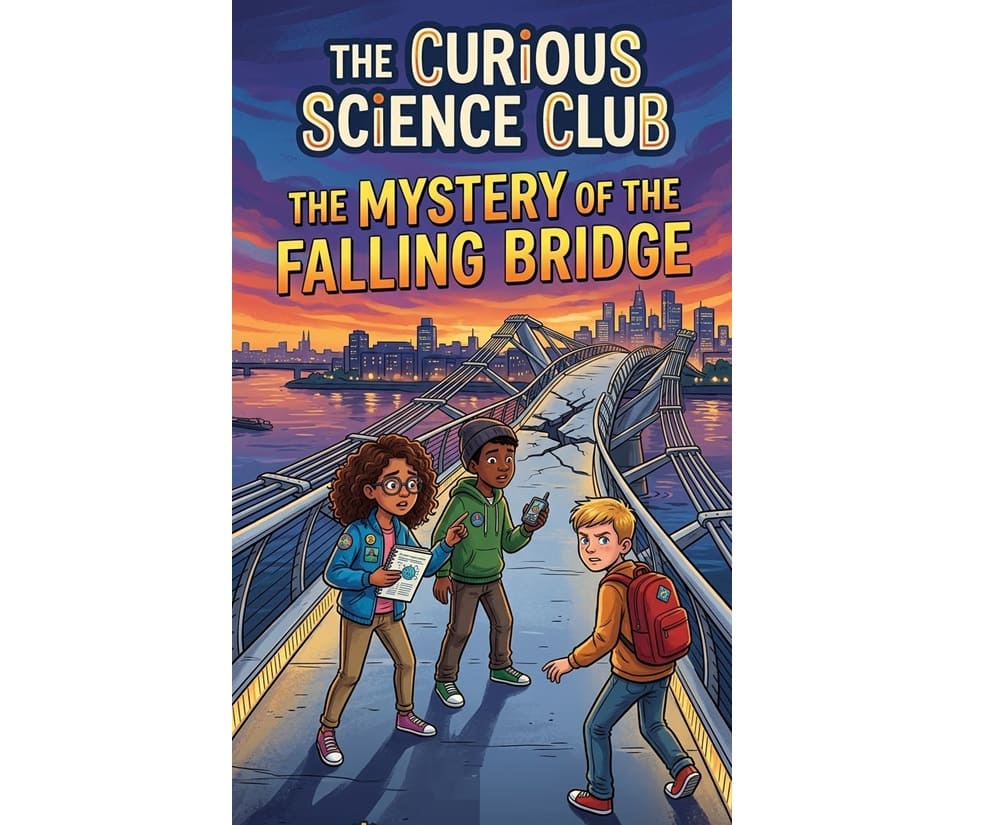
Chapter 1: The Science Fair Challenge The cafeteria at Maplewood Elementary usually smelled like mystery meat and overcooked broccoli, but today, it smelled like competition. Principal Miller stood on a plastic chair in the center of the room, waving a bright neon-orange flyer. "Listen up, future engineers! This year, the Annual Spring Science Fair isn’t about erupting baking-soda volcanoes or how much sugar is in a soda can. This year, we are going big. We are going structural!" Leo leaned forward, his glasses sliding down his nose. He adjusted them with a finger. Beside him, Maya was already sketching something in her battered notebook. Sam, however, was busy trying to see how many tater tots he could balance on his plastic fork. "The challenge," Principal Miller announced, his voice echoing off the tile walls, "is to build a bridge. It must span a two-foot gap, be made of nothing but wooden sticks and school glue, and—most importantly—it must hold the weight of 'Big Bertha,' the school’s heaviest encyclopedia." The room erupted in whispers. Big Bertha was famous. It was four inches thick and weighed more than a bowling ball. "A bridge?" Sam muttered, his tater tot tower finally collapsing. "That sounds like a lot of work for a piece of road you just walk across." Maya stopped sketching and looked at him, her eyes bright. "A bridge isn't just a piece of road, Sam. It’s a masterpiece of physics! It’s a battle against gravity! If we win, we get the Golden Gear Trophy." Sam paused. The Golden Gear was legendary. It was spray-painted gold, but it looked like something a real scientist would own. "Okay, I’m in. But only if we don't have to wear lab coats. They’re itchy." "Deal," Leo said, pulling a fresh pen from his pocket. "We need a name. Every great team has a name." Maya looked at the flyer, then at the messy table in front of them. "We like asking questions. We like solving mysteries. How about... The Curious Science Club?" "I like it," Leo nodded, scribbling it at the top of a clean page. "First order of business: The Blueprint. If we’re going to beat the fifth graders, we can't just slap sticks together. We need a plan." "I already have one," Maya said, turning her notebook around. She had drawn a bridge that looked like a giant, complicated roller coaster. "It’s going to be the tallest, most beautiful bridge Maplewood has ever seen." Leo looked at the drawing. It was impressive, but something felt off. He wasn't an expert yet, but he knew one thing about bridges: they didn't just have to look good. They had to stay up. "It looks great, Maya," Leo said slowly. "But how do we make sure it doesn't end up like Sam’s tater tots?" Sam grinned, popping a tot into his mouth. "Easy. We use a lot of glue. Like, all the glue." Leo sighed. He had a feeling it was going to take more than just extra glue to survive Big Bertha. The Curious Science Club had their first mystery: How do you make a few pieces of wood stronger than a giant book? The clock was ticking. They had exactly seven days to find out. |
One thing I noticed while using STEM Adventure Story Prompts for Kids is that it really helps when you don’t want to start from a blank page. The prompts already guide the direction of the story, so you’re not stuck trying to figure out what happens next.
Another thing I appreciated is that the prompts are designed around situations kids can easily imagine — things like experiments, building projects, or solving small everyday problems. That makes the stories feel relatable rather than overly technical.
And since the pack includes 500 prompts, I definitely didn’t feel like I would run out of ideas anytime soon.
From a practical point of view, it’s also useful because of the PLR rights. That allowed me to modify the content, change story directions, and use it for my own projects without worrying about restrictions.
If I’m being realistic, I wouldn’t say the product does everything automatically. You still need to edit, organize the chapters, and polish the content to make it feel natural. But compared to starting from scratch, it saves a lot of time and makes the process smoother.
For someone who wants to create children’s STEM books, activity books, or educational materials, I think STEM Adventure Story Prompts for Kids is a helpful resource to have. It’s simple to use, the ideas are practical, and the prompts are structured in a way that actually helps you move forward with a project.
If you’re planning to create educational content for kids — or even just want to experiment with STEM storytelling — it’s definitely worth taking a look at STEM Adventure Story Prompts for Kids and seeing how you might use it for your own projects.